Views: 0 Author: Site Editor Publish Time: 2026-10-11 Origin: Site
Walk the production line, and you will quickly notice a harsh reality. Up to 70 percent of all soldering defects start right at the beginning during the paste printing process. Achieving the perfect volume remains a relentless challenge for production engineers. Components inevitably shrink. Stencil openings become virtually microscopic. The margin for error completely evaporates. Enter the squeegee blade. This simple tool dictates the complex fluid dynamics of the solder paste.
This article breaks down the foundational physics of blade inclination. We will explore the critical nuances between standard industry setups and provide troubleshooting tactics for common defects. Furthermore, investing in high-quality equipment, such as a reliable pcb printer machine, can eliminate fluctuating variables to drastically boost your manufacturing yield.
Key Takeaways
Downward Force Dynamics: A lower blade inclination increases downward pressure. This forces more material into the cavities. A steeper posture reduces this downward force.
The 60-Degree Standard: 60 degrees remains the universally accepted industry standard for typical surface mount processes. It provides an optimal balance of paste roll and cavity filling without causing scooping.
Interconnected Variables: The attack posture does not operate in a vacuum. It must be perfectly calibrated with speed, applied pressure, and separation speed.
Equipment Matters: Modern printing systems allow for precise programmable control. This ensures repeatable filling that manual or semi-automated machines simply cannot match.
To truly master the process, one must first understand the basic function of the blade. It is not merely a wiper dragging material across a metal sheet. Instead, its primary job is to push a bead of paste across the stencil. This generates a continuous rolling action. This specific motion shears the material and momentarily alters its viscosity. It effectively forces the paste into the microscopic holes to rest perfectly onto the pads below. Picture the tool not as a broom, but as a dynamic fluid pump.
Why does this rolling action matter so much? The secret lies in rheology. Solder paste is thixotropic. Its physical state changes under stress. It becomes significantly more fluid when agitated and stiffens when left alone. The inclination of the blade is directly responsible for creating this optimal rolling motion. If the material slides instead of rolls, the necessary shear-thinning never occurs. This results in clogged openings and disastrously low transfer efficiencies.
At its core, filling these tiny spaces is governed by vector physics. As the blade moves forward across the stencil, its inclination determines how much mechanical force is directed forward versus downward. A steeper posture directs the majority of the energy forward. This pushes the bead along the surface. In contrast, a shallower posture redirects more kinetic energy downward. This drives the material deep into the cavities.
This downward force creates localized hydraulic pressure right at the microscopic edge where the metal meets the stencil. This intense pressure is exactly what injects the material into challenging spaces. Specifically, the geometry affects the ability of the paste to release cleanly from both the blade and the vertical walls of the stencil.
Recent industry analyses on fluid dynamics highlight a massive shift towards ultra-fine pitch components. We are seeing a rapid adoption of 01005 and 0201 metric packages across consumer electronics. As area ratios drop below the traditional 0.66 safety threshold, manufacturing engineers are forced to scrutinize their setup parameters. Relying solely on legacy standards is no longer sufficient for cutting-edge assemblies. Dynamic inclination adjustment combined with advanced nano-coated stencils is becoming a critical industry requirement to overcome the intense capillary forces inherent in miniaturized designs.
Selecting the right blade geometry is a critical engineering decision. To make this easier, we have compiled a core comparison standard below.
Parameter | 60-Degree Blade | 45-Degree Blade |
|---|---|---|
Downward Hydraulic Pressure | Moderate | High |
Paste Roll Quality | Excellent continuous roll | Good, but prone to sliding if speed is wrong |
Risk of Scooping | Very Low | High on large openings |
Best Application Scenario | Standard surface mount components | Ultra-fine pitch and stepped stencils |
For the vast majority of standard applications, the 60-degree blade is the universally accepted industry standard. It offers the most forgiving operational window. The primary benefit of this geometry is excellent paste roll. It also prevents the edge from digging into larger openings. This prevents scooping and ensures a flat deposit while leaving the top surface immaculately clean.
In addition, there are specific scenarios where a 45-degree setup becomes highly beneficial. When running heavily populated boards with ultra-fine pitch components, extra downward hydraulic pressure is required. This shallower posture forces material into challenging high-aspect-ratio holes. However, operators must be cautious. The risks include accelerated wear on the surface and a higher potential for bleed-out underneath the gasket.
One of the most frequent defects on the line is starvation. This typically occurs when the attack posture is too steep or when a heavily worn edge has lost its sharpness. In these instances, the setup fails to generate enough downward hydraulic pressure. The material simply rolls over the holes without fully penetrating them. This results in weak and unreliable joints after reflow.
Scooping is the exact opposite problem. When the posture is too low, the tool flexes under pressure. As it travels over large spaces, the flexible edge literally dips into the hole. It scoops out the material that was just deposited. This leaves a concave volume that causes open circuits.
Incorrect geometries do not just affect the inside of the hole. They affect the bottom of the stencil as well. If the downward pressure is excessive, material can be forced underneath the gasket. This smearing leads to bridges and catastrophic electrical shorts during the reflow process.
Understanding the printing triangle of speed, pressure, and geometry is useless without the right machinery. Upgrading your line requires looking at specific measurable capabilities. Manual adjustments rely entirely on operator feel. This makes consistent fluid dynamics nearly impossible across a long shift.
When evaluating an automatic stencil printer, process engineers must demand closed-loop feedback systems. High-end automated systems utilize motorized heads and sophisticated load cells. They provide real-time pressure feedback. If the viscosity changes due to factory floor temperature shifts, the machine adapts instantly.
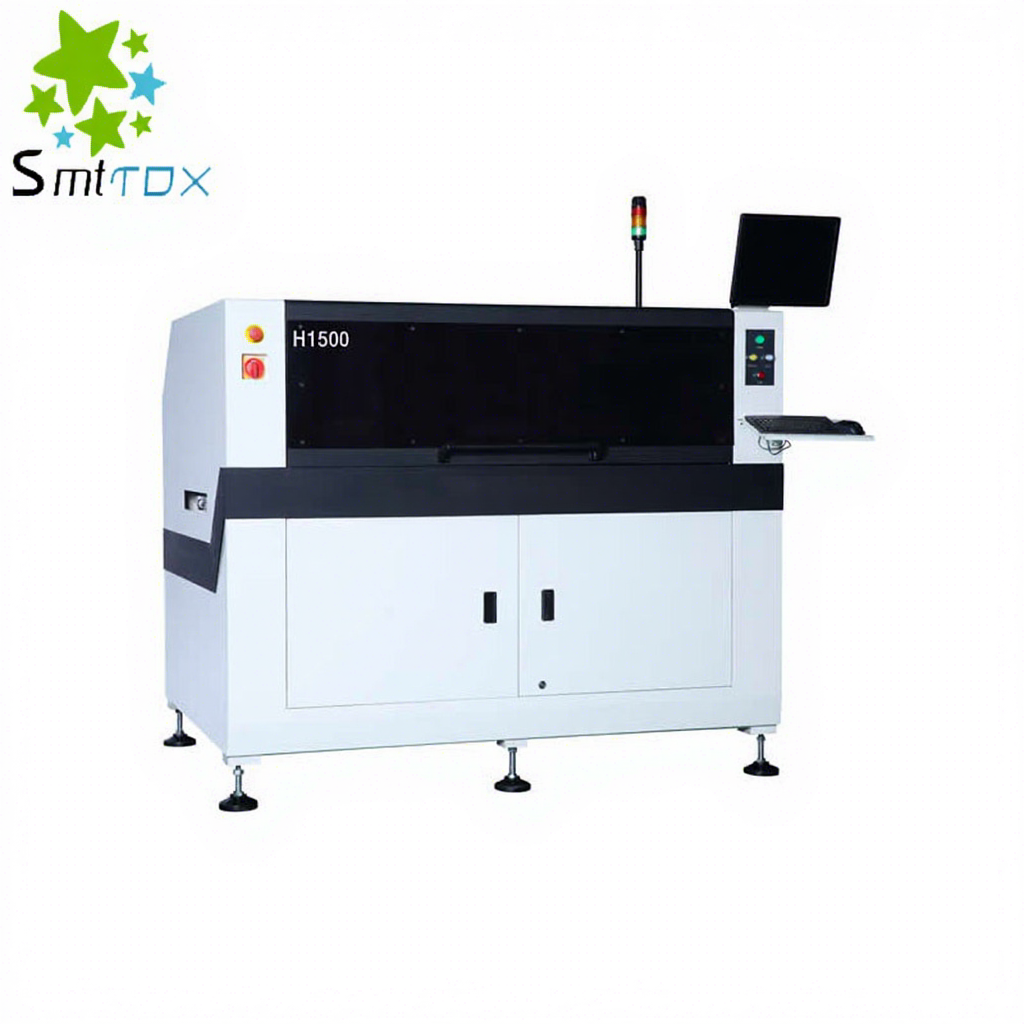
Specifically, a top-tier GKG PCB printer like the GKG H1500 sets the benchmark. It features programmable pressure ranging from 0.5 to 10 kilograms. It maintains a core cycle time of under 8.5 seconds. Its alignment accuracy hits plus or minus 12.5 microns at 6 Sigma. This structural rigidity ensures that the programmed geometry does not deflect during the stroke. It maintains absolute hydraulic consistency. For manufacturers struggling with complex boards, this level of precision is the only viable commercial solution. It drastically reduces downstream rework and directly boosts profitability.
Conclusion
Ultimately, blade inclination is a fundamental driver of fluid dynamics. The deliberate choice between different geometries directly impacts the downward pressure required for successful filling. While understanding the underlying vector physics is crucial, having the right equipment to execute those parameters flawlessly is non-negotiable. We highly encourage production teams to evaluate their current yield critically. Upgrading to a state-of-the-art automated system locks in your process parameters. To explore precision equipment tailored to your production needs, discover the perfect solution for your line at https://www.smtwenzhan.com and eliminate end-of-line defects today.
The industry standard is typically 60 degrees. This specific geometry provides the best balance of forward rolling action and downward hydraulic pressure. It is highly effective for most standard components and typical stencil thicknesses without causing paste scooping.
Speed dictates how much time the solder paste has to roll and physically drop into the cavities. If you use a standard 60-degree setup but run the stroke too fast, the paste may skip over fine holes due to a lack of dwell time. Speed and posture must always be calibrated together based on the specific viscosity of the paste being used.
While the geometry itself does not directly cause the solvent in the paste to evaporate, an incorrect setup that fails to roll the paste properly leads to a lack of shear-thinning. Without this agitation, the thixotropic paste can stiffen or stick to the stencil. This mimics the visual and operational effects of dried-out paste.
An automated system fundamentally removes human inconsistency from the equation. It provides motorized software-controlled pressure, precise posture maintenance, and automated optical inspection. This guarantees that the critical fluid dynamics required for proper filling remain absolutely identical from the first board to the last.
Top-tier systems feature advanced closed-loop pressure control, incredibly high-rigidity print heads, and precise optical alignment systems. This robust architecture ensures that whatever parameters you program are maintained perfectly across the entire surface of the board. This effectively eliminates starvation and scooping defects.
Yes. Metal blades are rigid and maintain their programmed true geometry throughout the stroke. Polyurethane blades tend to flex under heavy pressure. This flexing artificially lowers the effective attack posture during the print, which can inadvertently increase downward force and cause unexpected scooping.
Blades should be inspected daily and replaced every few months depending on production volume. A worn edge loses its sharpness and alters the contact area. This severely disrupts the hydraulic pressure required to push paste into fine-pitch cavities, regardless of how perfectly the machine is programmed.