Views: 0 Author: Site Editor Publish Time: 2026-11-24 Origin: Site
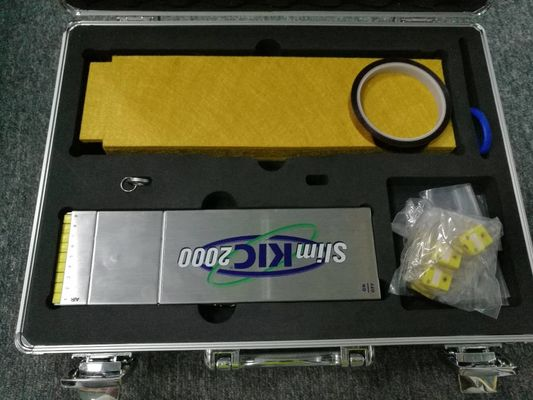
Short answer: The Slim KIC2000 is a KIC thermal profiler for reflow soldering — a battery-powered recorder that travels through the oven with the board and logs temperature against time, so the profile is measured at board level rather than inferred from oven setpoints. It records on 9 or 12 K-type thermocouple channels (the listing states both), covers -150°C to 1050°C at ±1.2°C accuracy, and reduces profile quality to a single Process Window Index (PWI) number, where lower is better.
A profiler is a measuring instrument, not process equipment — it does not control the oven, and on an SMT line it answers a narrower question: at the board, at the joints, what temperature history did the product actually see?
That question matters because oven setpoints are not a profile. Setpoints say what the machine was told to do; the profile says what the board experienced, which depends on belt speed, thermal mass, loading and airflow. Two reflow ovens set to the same zones can deliver different board-level profiles.
The loop is short: define the window from the paste specification, run a profile, compare the curve to that window, adjust the oven, run again. A profiler makes each turn fast enough to be routine, which is why it is usually the first measurement tool a line buys after the oven.
Item | Published value |
|---|---|
Product name | Slim KIC2000 KIC Thermal Profiler |
Model | KIC2000 |
MOQ | 1 piece |
Thermocouple type | Type K, 9 or 12 channels |
Measuring temperature range | -150°C to 1050°C |
Accuracy | ±1.2°C |
Resolution | Variable 0.3°C to 0.1°C |
Internal operating temperature | 0°C to 105°C |
Power | 9V alkaline battery |
Thermal receiver | 433.92 MHz |
System compatibility | Personal computer |
Dimensions | 323 × 86 × 26 mm |
The listing disagrees with itself in two places, and both affect what you receive:
Channel count. The attribute area appends "9 Channels" to the dimensions line, while the thermocouple fields read "9/12" and "Type K, 9 or 12". Treat 9 and 12 as two available configurations and have the quotation state which one.
Dimensions. The technical specification paragraph says "See Temperature Tolerance Chart below for specifications" — there is no such chart on the page. The 323 × 86 × 26 mm figure comes from the attribute area; no tolerance data is published, and none has been filled in here to replace the missing chart.
The process window is the set of limits the profile must stay inside — ramp rate, soak, peak, time above liquidus — and the listing states the software takes them from the paste supplier's specification and defines the window automatically.
PWI is how the software reports the result: instead of eyeballing four or five limits, it measures how well the curve fits the window and expresses that as one number. Lower is better. Its practical value is ranking: when two profiles both look acceptable on screen, PWI shows which sits closer to the centre of the window, and so has more room before drift pushes it out.
Out-of-specification conditions are flagged with colour-coded signals, so a failing zone is visible rather than buried in a table.
One boundary worth stating: PWI ranks a profile against the window you gave the software. It is a fit metric, not a prediction of joint quality — visual or X-ray inspection still decides that. Reading PWI as a quality guarantee is the commonest misuse of this tool.
The listing describes a built-in library containing hundreds of commonly used solder paste specifications, and the workflow that follows from it: select the paste, and the software defines the process window from that paste supplier's specification.
That is what makes profiling routine rather than specialist work: no typing limits from a datasheet for a paste already in the library, and a simplified interface that walks the operator through the run.
Two things the page does not say, and worth asking: what happens with a paste not in the library, and how the library is updated. Neither is an objection; both decide how much of your paste range the tool covers on day one.
The listing describes two versions of the same instrument:
Datalogger model — data is downloaded to the computer through a cable after the run.
Dual Unit model — data is sent to the computer in real time during the run, and also stored internally for high-speed operation (the page's sentence is cut off at that point).
The choice follows how you work: post-run analysis suits a line that profiles on a schedule and reviews afterwards; real-time suits interactive oven tuning, where an engineer changes a zone and wants the next curve without retrieving and downloading the unit.
The listing does not say which version is in stock or which a quotation refers to. Ask in writing, and confirm whether the 433.92 MHz receiver is part of the offer — real-time transmission depends on it.
Channel count is a coverage decision: more channels means more measurement points across a panel with uneven thermal mass, plus a reference point — a common arrangement (general practice, not a specification of this unit).
K-type thermocouples are the standard choice across this range. Note the two temperature figures are not the same thing: the thermocouples measure -150°C to 1050°C, while the instrument's internal operating temperature is 0°C to 105°C. The second governs how the electronics survive the oven — which is why a profiler is a compact recorder, not an instrument that stays in the heat.
How the thermocouples are fixed is a process decision, not a product one. High-temperature tape or adhesive at the joint of interest is the usual approach (industry practice), and it affects the reading at least as much as the accuracy figure.
Before changing anything, run a profile on a representative board to establish a baseline (industry practice). Re-profile when the paste, board or panel changes, or after oven maintenance that could shift airflow or zone behaviour (industry practice). Those triggers are process discipline, not seller conditions.
On arrival, a short sequence covers most of what can go wrong: power the unit on a fresh 9V battery, check that every channel reads ambient consistently, pair the receiver if the version uses one, install the software, download a run and compare it against a known-good result from your line. Thermocouples and cables are consumables, and SMT parts are listed alongside the instrument.
Four commercial items are not on the listing and belong in the quotation: price, warranty, packing and delivery, and what is in the box — thermocouples, cable, software licence, software version and operating system. The page says "personal computer" and stops there.
What accuracy and range does the KIC2000 offer? ±1.2°C accuracy, a measuring range of -150°C to 1050°C, and resolution variable between 0.3°C and 0.1°C.
Does it have 9 or 12 channels? The listing gives both. The dimensions line says "9 Channels", while the thermocouple fields say "9/12" and "Type K, 9 or 12". Confirm the configuration on the quotation.
What is the difference between the Datalogger and Dual Unit versions? The Datalogger downloads to a PC by cable after the run. The Dual Unit transmits in real time during the run and also stores data internally. The listing does not state which version is being quoted.
What does PWI mean? Process Window Index — a single number describing how well the measured profile fits the process window, where a lower value is better. It is used to compare and rank profiles, not to certify joint quality.
What is included with the unit? The listing does not say. Thermocouples, cable, software licence, software version and operating system support all need to be confirmed in the quotation.
Do I need a specific reflow oven brand to use it? No oven-brand compatibility is claimed on the listing. The instrument measures the board's temperature history and works with a PC; what you need to confirm is the software environment and thermocouple arrangement.
Tell us the channel count, the version you want and the paste range your line runs, and the configuration is confirmed with the commercial terms — Slim KIC2000 KIC Thermal Profiler.
Contact: Tel/WhatsApp +8618823383970 · Email wenzhanhucai@163.com Follow: Facebook https://www.facebook.com/smtwenzhan/ · YouTube https://youtube.com/@wenzhan-p1d · Instagram https://www.instagram.com/vivian_tdx/