Views: 0 Author: Site Editor Publish Time: 2026-10-27 Origin: Site
In the fast-paced world of Surface Mount Technology manufacturing, every single production second counts. Bottlenecks at the very beginning of your production line can severely throttle the efficiency of your entire factory. This often results in delayed shipments and significantly reduced profitability. Acting as the production heartbeat, a full automatic PCB loader is responsible for feeding bare boards into downstream equipment with unwavering precision and high speed.
But exactly how fast can this automated equipment actually cycle? In this comprehensive guide, we will break down average cycle times and explore the mechanical factors that influence these operational speeds. Furthermore, we will discuss how optimizing your loader can seamlessly feed into advanced equipment like an Automatic Solder Paste Printing Machine. Whether you are upgrading your facility or actively troubleshooting current bottlenecks, this article provides the crucial engineering insights needed to maximize your factory throughput safely.
Key Takeaways
In electronics manufacturing, the fundamental purpose of this handling equipment is to automatically dispense unpopulated Printed Circuit Boards from a stacked protective magazine directly onto the conveyor system. By fully automating this initial feeding process, manufacturers completely eliminate the need for manual handling. This reduction in human intervention provides measurable and immediate benefits. It drastically lowers the risk of Electrostatic Discharge damage, prevents particulate contamination on sensitive solder pads, and mitigates the inevitable risk of human error. Consequently, a reliable loader stabilizes the entire surface mount technology process, establishing a consistent baseline throughput potential for the assembly line.
The operation relies on a highly synchronized sequence of mechanical and electronic events. In a typical factory scenario, an operator manually slides a fully loaded magazine into the machine clamping platform. A distinct hiss of pneumatic actuators then locks the rack securely in place. Next, a motorized elevator mechanism vertically aligns the first occupied slot of the magazine with the downstream conveyor belt.
Once perfectly aligned, a pneumatic or motorized pusher rod extends forward very carefully. It gently slides the bare board out of the magazine slot and onto the conveyor rails. Finally, the loader communicates with the next machine using the industry-standard SMEMA protocol. Advanced optical sensors confirm the board has successfully exited the loader mechanism before the elevator swiftly indexes to the next available slot.
When evaluating factory throughput, the primary metric is the single board transfer time. Industry benchmarks indicate that most modern board handling equipment achieves a transfer cycle time of 5 to 10 seconds per board. This operating speed is heavily influenced by the pitch, which is the vertical distance between individual board slots within the storage magazine. If the pitch is small, the elevator requires significantly less time to index to the next position. High-speed models optimize this elevator movement, allowing the pusher mechanism to actuate almost immediately after the previous board clears the conveyor sensor. Under ideal conditions, this pushes cycle times down to just 4 or 5 seconds.
While single board transfer times dictate micro-efficiency, the macro-cycle time is dictated by magazine changeovers. When a rack is fully depleted, the machine must safely eject it and position a fresh, fully loaded magazine. This mechanical swap typically takes 20 to 30 seconds. During this brief window, no boards are fed into the production line.
Recent market analyses reveal a distinct pivot in SMT automation toward smart manufacturing principles. Modern PCB loaders are evolving into data-driven nodes rather than simple mechanical feeders. The industry is seeing a surge in demand for handling equipment integrated with predictive maintenance algorithms and AI-driven speed optimization. Instead of running at a fixed static rate, next-generation loaders dynamically adjust their cycle times based on real-time downstream bottlenecks. This reflects a broader manufacturing trend to maximize Overall Equipment Effectiveness while minimizing micro-stoppages across the factory floor.
The laws of physics play a major role in automated printed circuit board handling, directly dictating the maximum safe operating speed. Larger and heavier boards, such as thick server motherboards or heavy copper power supply boards, must be handled with much slower acceleration and deceleration profiles. If a heavy board is pushed too rapidly, its kinetic energy can cause it to overshoot the conveyor sensors or shift out of alignment. In contrast, small and lightweight boards used in mobile phones or IoT devices can be processed at the maximum rated speed of the machine without risking mechanical instability.
The internal drive mechanics of the elevator and pusher systems are critical to shaving off cycle seconds. Entry-level loaders typically utilize standard stepper motors. While generally reliable, stepper motors operate on an open-loop system and require slower movement profiles to prevent skipped steps and maintain position accuracy. Furthermore, high-end loaders utilize advanced servo motors equipped with closed-loop feedback systems. Servo motors provide faster, smoother, and highly precise movements. They can accelerate rapidly and brake smoothly, shaving critical fractions of a second off each index and push cycle.
Regardless of robust mechanical capabilities, a full automatic PCB loader can only cycle as fast as the next machine allows. The Surface Mount Equipment Manufacturers Association protocol governs the traffic control on the production line. The loader relies on a low-voltage signal from the downstream equipment indicating it is ready to receive a board. If the downstream machine is busy processing, the loader remains idle. Optimizing SMEMA signal response times and ensuring robust cable connections can shave milliseconds off cycle times. Over a long production shift, these saved milliseconds compound significantly.
Manufacturing efficiency relies heavily on a concept known as line rhythm. A production line is only as fast as its slowest bottleneck. If a loader is capable of cycling in 6 seconds, but the subsequent machine requires 15 seconds to process the board, the loader will spend more than half of its time waiting. This creates an unbalanced production flow. Conversely, if the downstream equipment is faster than the loader, the expensive processing machines will sit idle. Balancing these cycle times ensures continuous and uninterrupted manufacturing operations.
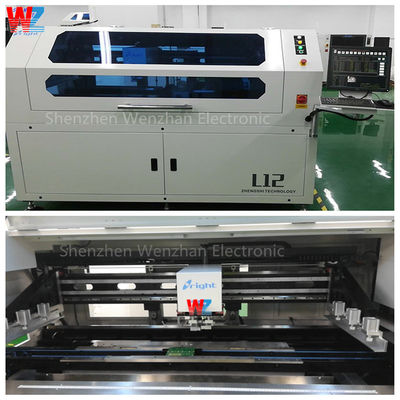
To maximize line efficiency, high-speed loaders are often paired with equally capable downstream equipment. For instance, when feeding boards into an L12 automatic solder paste printer, the loader must maintain a consistent output. This specific printer model is designed to handle precise dimensions down to 80x50mm, requiring the loader to match its rapid optical alignment and squeegee cycles perfectly. Matching a fast loader with a precision printer guarantees that the printing machine is never starved for bare boards. This vital synchronization maximizes the utilization rate of your most capital-intensive equipment, ensuring continuous solder paste deposition and preventing paste dry-out issues associated with prolonged idle times.
While achieving a 4-second cycle time is technically impressive, pushing equipment beyond its optimal physical limits introduces severe quality control risks. A common pain point in fast-paced SMT facilities is PCB damage caused by overly aggressive loader settings. When boards are pushed too fast, the friction and impact can lead to scratched solder masks, chipped FR4 edges, or displaced fiducial markers. In extreme cases, rapid deceleration can cause boards to drop from the conveyor rails. This leads to scrapped multi-layer boards that instantly negate any fractional time saved during the loading process.
To mitigate these risks while maintaining high throughput, modern loaders incorporate advanced safety and handling features. Variable speed pushers allow operators to program custom acceleration curves tailored to specific board weights. Specifically, optical sensors are strategically placed to detect jams, misalignments, or cross-threaded boards within the magazine before physical damage occurs. Smooth elevator braking systems prevent the rack from jolting the boards vertically, and anti-static belts prevent electrostatic discharge during rapid transfers. These rigorous engineering standards ensure that even at maximum cycle speeds, manufacturing quality is never sacrificed.
When evaluating handling equipment, manufacturing engineers often compare full automatic machines with semi-automatic alternatives. Semi-auto systems require an operator to manually load bare boards onto a staging platform or constantly swap single magazines by hand. This reliance on human labor introduces natural and unpredictable delays into the production line. Operators experience fatigue, take breaks, and may not react instantly when a magazine empties. A full automatic PCB loader operates continuously. It manages its own magazine queues and maintains a mathematically predictable cycle time that is completely immune to human fatigue.
The financial justification for upgrading to fully automated systems becomes blatantly evident when calculating long-term throughput. Saving just a few seconds per board translates to significant volume increases. Consider a production line running 2,000 boards per day. Saving 3 seconds per board recovers over 1.5 hours of lost production time daily. Eliminating human intervention translates to hundreds of extra processed boards over a single shift, directly increasing overall factory output and profitability.
High-speed loading at the front of the line is entirely futile if finished boards pile up at the end of the line. The production flow must be a balanced equation. After PCBs pass through the reflow oven and Automated Optical Inspection systems, they must be securely collected. An automatic SMT PCB unloader conveyor receives these processed boards safely. Often, these systems integrate a 1-meter inspection conveyor section, allowing operators a final visual check before the boards are automatically pushed into an empty magazine. This completes the fully automated and hands-free electronics manufacturing loop, preventing finished boards from colliding and scratching.
To maintain a continuous operation, the end-of-line equipment must feature a cycle time equal to or faster than the input equipment. If the unloading mechanism cannot keep pace, the entire SMT line will trigger a cascade of SMEMA stop signals. This halts production completely until the bottleneck is cleared. Investing in matched handling equipment ensures that processed boards are safely caught and stored at the same rapid pace they were initially loaded. This simplifies maintenance and operator training while preventing dangerous line-stopping bottlenecks.
Selecting the appropriate loader requires an objective engineering analysis of your specific manufacturing environment. Facilities operating on a High-Mix Low-Volume model should prioritize loaders with rapid motorized width adjustments and highly flexible software interfaces. This saves valuable minutes during frequent product changeovers. Conversely, factories utilizing a Low-Mix High-Volume model should focus heavily on raw cycle speed, heavy-duty servo motors, and multi-magazine buffer capacities to support continuous 24/7 operations without mechanical degradation.
When reviewing equipment datasheets, production managers should evaluate several critical specifications to ensure the machine meets their operational demands:
| Specification Feature | Entry-Level Loader Model | High-Speed Production Model |
|---|---|---|
| Average Cycle Time | 8 to 12 seconds | 4 to 7 seconds |
| Motor Technology | Stepper Motor System | Closed-Loop Servo Motor |
| Magazine Changeover | 30 to 40 seconds | 15 to 25 seconds |
| Best Factory Application | High-Mix Low-Volume | Low-Mix High-Volume |
Always verify the maximum magazine capacity, machine footprint, and official CE certifications to guarantee adherence to industrial safety standards before finalizing a purchase.
Conclusion
A full automatic PCB loader dictates the pace and rhythm of your entire SMT production line. While achieving cycle times of 5 to 10 seconds is standard for high-quality machines, true manufacturing efficiency is realized by perfectly balancing this input speed with downstream equipment. By understanding the mechanical factors at play, from servo motor technology to board weight profiles, you can optimize your handling equipment to prevent substrate damage and eliminate micro-stoppages. Assess your current line speeds today, identify your hidden bottlenecks, and invest in robust automated handling equipment to future-proof your manufacturing capabilities. To find the perfect match for your production needs, explore the advanced handling solutions and high-precision printers available at smtwenzhan.com.
FAQ
Most modern full automatic PCB loaders cycle a single board in 5 to 12 seconds. This depends heavily on the machine motor technology and the pitch of the magazine. Magazine changeovers typically take roughly 20 to 30 seconds.
They communicate seamlessly via the industry-standard SMEMA protocol. The downstream printer sends a low-voltage ready signal to the loader. This prompts the machine pusher mechanism to dispense the next bare board onto the conveyor.
Yes. Most industrial loaders feature adjustable magazine clamping platforms and variable conveyor widths. This allows them to handle a diverse range of board sizes. These physical adjustments can usually be made quickly via a manual hand crank or an automated motorized system.
Slower cycle times are most often caused by downstream bottlenecks, meaning the loader is simply waiting for the next machine to finish processing. Other culprits include improper optical sensor calibration or using a heavier board profile that requires the operator to program a slower acceleration curve to prevent physical damage.
It is highly recommended for smooth factory operations. To maintain a continuous hands-free production line and prevent dangerous end-of-line bottlenecks, an automatic unloader is essential. It safely catches, organizes, and stores the finished boards at the exact same speed they are loaded.
True throughput is calculated by identifying the slowest machine in your assembly line, which acts as the primary bottleneck. You must measure the cycle time of this specific machine and factor in the loader magazine changeover times, routine maintenance stops, and product changeover durations to determine your actual boards-per-hour yield.
Jams are typically caused by warped PCBs, debris inside the magazine slots, or incorrect pitch settings on the elevator mechanism. Running a heavy board with an aggressive acceleration profile can also cause the board to shift diagonally during the push cycle, triggering a sensor fault and halting the machine.