Views: 0 Author: Site Editor Publish Time: 2026-10-19 Origin: Site
Are manual feeding delays slowing your Surface Mount Technology, or SMT, line? In today's highly competitive electronics manufacturing landscape, speed and precision demand absolute zero-defect production.
Yet, many facilities still rely on traditional manual board loading. This outdated practice invites severe risks of static damage and creates costly production bottlenecks. The physical interaction between operators and sensitive substrates introduces an unpredictable variable into an otherwise highly controlled environment.
In this comprehensive guide, we will explore the fundamental differences between manual methods and automated solutions. By understanding these operational impacts, plant managers and production engineers can make informed, ROI-driven decisions to upgrade their scalable, high-yield SMT lines.
To truly grasp the operational impact of upgrading an assembly line, we must establish a direct comparison of manual feeding and automated loading. The differences extend far beyond mere convenience. They fundamentally alter the baseline metrics of manufacturing efficiency.
Let us look at the data. On the factory floor, the contrast becomes stark when you measure actual output against theoretical capacity.
| Operational Metric | Manual Feeding | Full Automatic PCB Loader |
|---|---|---|
| Cycle Time Consistency | Highly variable, prone to micro-stops | Constant, programmable machine pacing |
| Contamination Risk | High risk of oils, dust, and ESD transfer | Zero physical contact, enclosed handling |
| Labor Requirement | Requires dedicated full-time operator | Periodic magazine replacement only |
| Alignment Precision | Inconsistent insertion angles cause jams | Stepper motor driven, perfectly parallel insertion |
Human physiology limits manual feeding. Operators get tired. As shifts drag on, attention spans shrink and reaction times fluctuate. These micro-stops kill your throughput. Imagine an operator looking away for just a few seconds to check a smartphone. If the downstream machine signals it is ready during that brief window, the entire line sits idle. Over an eight-hour shift, these accumulated micro-stops result in a severe loss of production volume.
In contrast, automated equipment operates at a relentless pace. It is meticulously designed to match the exact cycle time of the placement machines. When the downstream equipment signals readiness, the loader deploys the next printed circuit board instantly. There is no fatigue. There is no distraction. This continuous mechanical pacing ensures that high-speed placement machines are never starved for materials.
The physical handling of bare substrates requires delicate precision. However, manual handling introduces a high degree of variability. Operators may inadvertently push a board into the conveyor at a slight angle. This causes a micro-jam that triggers a cascade of alarms down the line. Forceful pushing can lead to jammed tracks. You then have to halt the line while manually extracting the wedged board.
Automatic loaders eliminate this frustrating variability entirely. They utilize precision stepper motors, pneumatic pushers, and optical sensors to ensure perfect board alignment every single time. The mechanical extraction from the magazine rack applies uniform pressure. This guides the board smoothly onto the conveyor rails perfectly parallel to the downstream equipment.
Relying on outdated manual processes in a modern electronics manufacturing facility creates hidden inefficiencies. Understanding these specific pain points is critical for plant managers evaluating process improvements at the bottom of the funnel.
The financial impact of human error is frequently underestimated. When an operator misfeeds a board, it jams the entry conveyor. Resolving this jam requires stopping the line, opening the safety enclosures, extracting the wedged board, and resetting the machine parameters.
This machine downtime is incredibly expensive. In high-volume manufacturing, a single minute of line downtime can equate to hundreds of dollars in lost revenue. Furthermore, boards physically damaged during a jam must be scrapped. The cumulative cost of scrapped substrates and lost production time quickly outweighs the perceived savings of avoiding capital equipment investments.
Before a board even reaches the soldering stage, it is highly vulnerable to its environment. Human hands naturally carry oils, moisture, and particulate dust. Specifically, when an operator touches a bare board, these contaminants transfer to the copper pads. This alters the surface tension during the reflow process, leading to poor solder wetting and weak mechanical joints.
More critically, manual handling introduces severe static risks. The human body can easily accumulate thousands of volts of static electricity. Meanwhile, modern electronic components can be degraded by as little as 50 volts. A static shock traveling through the traces causes latent damage to sensitive components. These latent defects often pass initial quality control but fail prematurely in the field.
Recent industry analyses reveal a distinct pivot toward smart manufacturing. We are seeing a massive labor shortage across the global manufacturing sector. Finding and retaining reliable operators to perform repetitive tasks like board feeding is becoming nearly impossible.
Furthermore, global electronics demand pushes components to shrink to microscopic sizes. As high-density interconnect boards become the standard, the physical margin for handling errors has vanished. Market trends show that facilities clinging to manual loading struggle to meet the strict traceability and yield requirements demanded by top-tier automotive and medical clients. The integration of modern data systems requires continuous, uninterrupted feeding without human-induced micro-stops. Consequently, automated PCB loaders are no longer viewed as luxury upgrades. They have become foundational necessities.
When evaluating different automated loading systems, plant managers must look beyond basic functionality. High-quality loaders possess specific engineering features designed to maximize uptime and facilitate smooth integration. You need to look at the actual specifications that impact daily operations.
The primary function of a loader is to hold a buffer of bare boards and dispense them sequentially. Standard industry magazines typically hold up to 50 boards. However, the true value of a high-end loader lies in its auto-switching mechanisms.
Advanced models hold multiple magazines simultaneously. Once the active magazine is depleted, the machine's motorized lift automatically ejects the empty rack and elevates the full one into the feeding position. This seamless auto-switching allows for continuous operation. An operator can remove empty magazines and load full ones without ever stopping the production line.
The physical dimensions of your product mix dictate the mechanical requirements of the loader. Buyers must rigorously verify the maximum and minimum board dimensions. For high-flexibility lines, you want equipment that handles a wide range. For example, standard high-precision machinery easily accommodates dimensions starting from 80x50mm up to 400x340mm.
Additionally, thickness and weight capabilities are critical. If your facility processes heavy copper boards or aluminum-backed substrates, the loader’s lifting motors must be rated for the extra weight. Ensure the machine features a robust, heavy-duty frame to prevent vibrations when indexing heavy magazines.
The initial entry point of a bare board sets the operational baseline for the entire production run. When integrating a front-end loader into an SMT line, the immediate downstream connection is typically the Automatic Solder Paste Printing Machine. The synergy between these two pieces of equipment dictates the baseline yield rate of the entire assembly process.
In electronics manufacturing, solder paste application is widely considered the most critical step. Industry data suggests that up to 70 percent of all assembly defects originate here. The transition of the bare board from the loader to the printer must be flawless. If a board is fed manually, inconsistencies in speed, angle, and force cause micro-misalignments on the printer's conveyor.
An automated loader eliminates this variability. By utilizing synchronized handoffs via standard SMEMA cables, the board arrives squarely and smoothly onto the printer's clamping system. The loader sends a signal, the printer confirms it is ready, and the transfer happens without mechanical shocks.
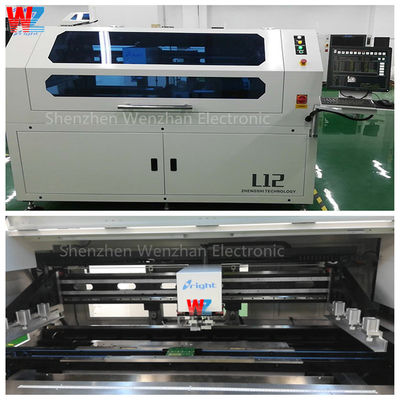
To maximize the capabilities of high-end printing equipment, the input mechanism must be equally precise. For instance, when pairing a loader with a high-performance unit like the L12 automatic solder paste printer, the benefits of automated loading become highly apparent.
Advanced printers utilize sophisticated vision systems to deposit paste with a repeat positioning accuracy of ±0.01mm. If a human operator feeds boards irregularly, this expensive printer sits idle. A full automatic loader ensures that the printer receives perfectly aligned boards at the exact right moment. The precision stepper motors push the board into the staging area without generating physical abrasion, allowing the fiducial recognition cameras to lock on instantly.
While optimizing the front end of the line is crucial, establishing a balanced production flow requires equal attention to the back end. Loading boards automatically is only half the battle. They must also be unloaded efficiently to prevent downstream bottlenecks.
An assembly line operates as a sequential system. If the front-end loader feeds boards at a rate of one every 15 seconds, the back-end equipment must receive completed assemblies at the exact same rate. Manual unloading presents a severe risk here. Picture a heavily populated board exiting the reflow oven. Manually handling this hot, valuable assembly invites disaster. An operator removing these boards risks dropping them or exposing them to late-stage static damage.
To maintain the steady cadence established by the front-end loader, the output mechanism must seamlessly receive and store boards without human hesitation.
The ultimate goal of modern manufacturing is to minimize human intervention. Combining a loader at the front with an automatic SMT PCB unloader conveyor at the back creates a fully autonomous closed-loop handling system.
Using a standard 1m inspection conveyor section between the oven and the unloader allows for brief visual quality checks before the boards are automatically indexed into receiving magazines. In this setup, operators no longer stand stationary at the ends of the conveyor. Their role shifts to periodic magazine management. This allows a single operator to manage multiple lines simultaneously.
For plant managers and production engineers, transitioning from manual feeding to automated loading requires a clear financial justification. Let us look at the math. While the upfront capital expenditure must be considered, the operational savings typically result in a highly favorable payback period.
The most immediate financial impact is the reduction in direct labor costs. Manual feeding requires a dedicated operator to stand at the front of the line for the duration of the shift. By automating this process, that operator can be reallocated to higher-value tasks, such as quality inspection or machine programming.
Across a three-shift operation, this equates to three full-time salaries dedicated solely to pushing boards into a machine. The cost savings from reallocating just one dedicated feeder often covers the capital cost of the loader within the first several months.
Assume a facility runs two shifts per day. Reallocating two dedicated operators saves tens of thousands of dollars annually in direct wages. Furthermore, the reduction in scrap must be factored into the equation.
If manual handling results in a 0.5 percent scrap rate on boards that cost 50 dollars each to produce, a facility assembling 10,000 boards a month loses 2,500 dollars monthly to handling defects. By eliminating these errors, the automated loader recovers that lost revenue. When combining labor reallocation savings, reduced scrap, and increased overall line yield, the payback period for a standard loader is frequently calculated to be between 6 to 12 months.
While manual feeding might seem like a cost-saving measure initially, the hidden costs of human errors, static damage, and production bottlenecks make it entirely unsustainable. Human inconsistency actively reduces your overall profit margins and jeopardizes product reliability on the factory floor.
A full automatic PCB loader is a foundational, smart investment. It not only solves the immediate problem of board handling but also amplifies the efficiency, precision, and longevity of every subsequent machine on the assembly line.
Do not let outdated handling methods throttle your manufacturing potential. Review your current line efficiency today. To upgrade your facility with high-precision printing machines, loaders, and unloader conveyors that perfectly match your production specifications, visit smtwenzhan.com and consult with specialized engineering teams to start your journey toward true automation.
It automatically extracts bare printed circuit boards from a stacked, enclosed magazine and feeds them one by one into an assembly line. This mechanized process eliminates the need for a human operator to stand at the front of the line and manually place each individual board onto the conveyor system.
Yes. Most modern loaders feature adjustable conveyor tracks and programmable pitch settings. This flexibility allows operators to easily switch between different board widths, lengths, and thicknesses during product changeovers, accommodating a wide variety of manufacturing requirements.
They communicate using industry-standard SMEMA cables and protocols. The downstream printer sends a ready signal to the loader when its internal conveyor is clear. The loader responds by feeding the board, ensuring a synchronized handoff so that no physical collisions or conveyor jams occur.
Routine maintenance is straightforward but critical. It involves cleaning the optical sensors to prevent false readings, lubricating the precision stepper motors and lead screws, and checking the pneumatic pushers for proper air pressure. Regular maintenance ensures the machine maintains its programmable cycle time without jamming.
Board thickness dictates the pitch settings within the magazine. If a board is too thin, it might warp and cause a misfeed. If it is too thick, it requires a wider pitch setting in the software to prevent the pneumatic pusher from scraping the substrate above it. High-quality loaders allow operators to program the exact pitch distance to match the specific thickness of the batch.